
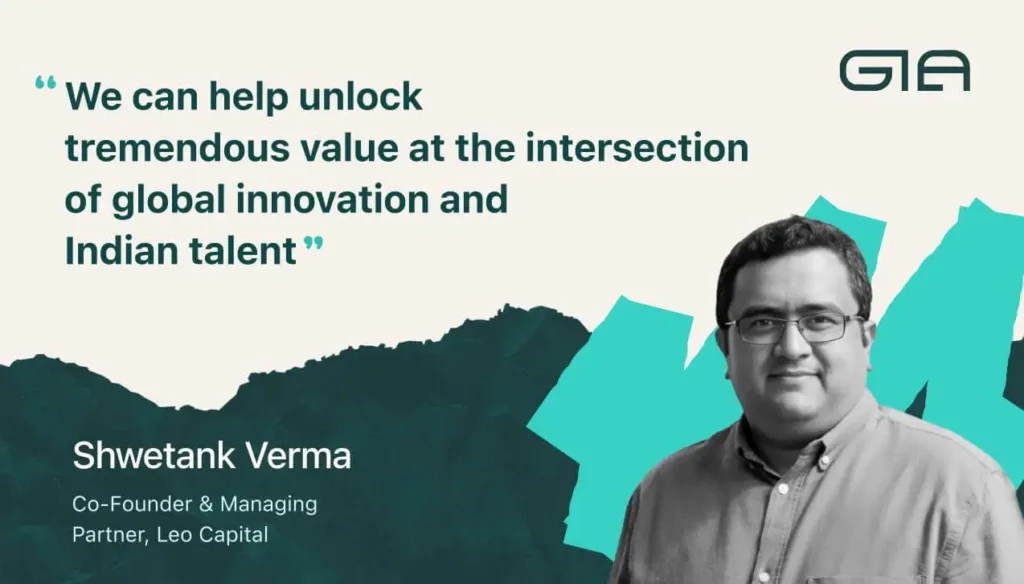
We sat down with Shwetank Verma, Co-founder and Managing Partner of Leo Capital, to explore the vision behind GIA, the untapped potential of the Indian diaspora in the global tech ecosystem, and how GIA aims to build bridges between global innovation and Indian talent.
Q: What is Global Indian Alpha, and what inspired its creation? What specific gap does it aim to fill in the global startup ecosystem?
Shwetank: Global Indian Alpha champions the achievements and innovation of Indians and Indian-origin individuals worldwide. When you look at the technology landscape today, a remarkable number of groundbreaking solutions—from classics like Hotmail to emerging AI tools such as Cursor and Perplexity—have been developed by Indian talent.
The Indian diaspora now comprises over 35 million people globally, and a significant portion of them are deeply embedded in the startup and technology ecosystem. What’s fascinating is that while many of these individuals are creating tremendous value in their adopted countries, the connection back to India’s talent pool and market opportunities often remains underutilized, especially at the early stages. GIA was born from recognizing this disconnect.
While Global Capability Centers (GCCs) have successfully tapped into Indian talent for scaled companies, there’s no systematic approach for early-stage startups founded by the Indian diaspora to leverage India’s advantages.
We aim to fill this gap by creating pathways for these ventures to connect with India at the seed to Series A stages, when such connections can be most transformative.
Q: Could you dive deeper into GIA’s mission and how you plan to execute it?
Shwetank: Absolutely. GIA serves as a strategic bridge, connecting the global Indian diaspora talent pool with India’s resources, both as a source of skilled professionals and as a potential market. While we’re happy to support companies at various stages, our sweet spot is definitely seed to Series A startups.
Our framework revolves around ‘TIME’ :
Talent: India is the world’s youngest major economy, with a median age of 28, and is projected to represent one-fifth of the global workforce by 2030. This isn’t just about numbers; it’s about highly skilled professionals with global sensibilities.
Today, there are approximately 1,600 GCCs employing 1.66 million professionals in India, and by 2025, the sector is expected to grow by 36%, adding 800 new centers that are expanding into Tier 2 and Tier 3 cities.
If established multinationals are harvesting significant benefits from Indian talent, early-stage startups should be able to do the same. However, they often lack the knowledge, networks, and confidence to build these connections effectively. That’s a gap we’re addressing.
Insights: India has developed unique approaches and solutions that are difficult to find elsewhere. Take Digital Public Infrastructure (DPI), for instance—innovations like Aadhaar (digital ID) and UPI (Unified Payments Interface) represent technological leapfrogging that’s attracting global attention.
India has emerged as a leader in models like quick commerce, where businesses are rapidly creating new operational playbooks. Many of these innovations can have global applications if properly translated to different markets.
A great example from our portfolio is Atoa, which is essentially bringing a Paytm-like model to the UK. It’s built by Indian founders, leveraging Indian insights and playbooks, but executing them for a completely different market. This kind of cross-pollination is what we’re aiming to facilitate.
Market Entry: Looking at India as a destination rather than just a talent source, the numbers are compelling. India’s digital economy is projected to reach $1 trillion by 2030, with the consumer market expanding to $4.3 trillion in the same timeframe.
On the B2B side, 89% of Indian businesses plan to increase software spending, with 40% expecting substantial increases of over 15%. SMEs are particularly bullish, with 86% planning increased investments—33% of them expecting to raise spending by 15% or more, significantly outpacing the global average.
This presents enormous opportunities for both B2B and B2C companies. The challenge is that even founders of Indian origin often lack the contemporary knowledge and connections to navigate this market effectively.
Q: Why do you believe now is the right time for an initiative like GIA?
Shwetank: The timing couldn’t be better for several converging reasons.
First, India’s demographic advantage is at its peak. As highlighted above, with a median age of 28, India has an abundance of young, educated talent entering the workforce annually. By 2030, India will represent approximately one-fifth of the global workforce.
Second, the quality of Indian talent has evolved dramatically. Today’s Indian professionals are globally acclimatized, with strong English proficiency and international exposure through education or work. There’s also significant untapped talent beyond the major cities that global companies haven’t fully discovered.
Third, the economic equation is increasingly compelling. As the fully loaded cost of talent in Western markets continues to rise due to taxes, benefits, and competition, the value proposition of accessing Indian talent becomes even more attractive. Mind you, this isn’t about cheap labor; it’s about accessing exceptional talent at a better overall value.
Fourth, in certain technological domains, India is a clear leader. The DPI movement I mentioned earlier is one example. Still, there are others in areas like fintech (built on top of UPI) where innovations from India are now being replicated globally.
Finally, the global startup ecosystem is facing headwinds with funding constraints and increased competition.
Being able to leverage Indian talent and potentially the Indian market provides a significant competitive advantage that can extend the runway, accelerate development, and create unique value propositions.
Q: Why is Leo Capital specifically building GIA?
Shwetank: At Leo Capital, we’re uniquely positioned to lead this initiative for several reasons.
We already operate across major geographies—India, Singapore, the US, and Europe—giving us firsthand insights into the opportunities and challenges of building global-Indian connections. GIA is our way of systematizing this hard-earned knowledge to benefit entrepreneurs who need it.
There’s also a personal dimension. Both Rajul Garg, (Founder and Managing Partner of Leo Capital) and I have lived experiences building and scaling businesses in Western markets while leveraging India. We understand both sides of the equation intimately, the opportunities and the pitfalls.
We’ve closely observed the specific challenges faced by founders of Indian origin outside India. Many have a desire to tap into Indian talent and markets but lack the current connections, knowledge, or confidence to do so effectively.
Sometimes, they’ve been away from India for so long that their networks are outdated, or they’re unsure about navigating contemporary Indian business practices.
The concept itself isn’t entirely novel; we’ve seen successful models in other countries like Israel and Japan, where diaspora connections drive significant value exchange. What’s been missing is someone to ‘own’ and orchestrate this specifically for the Indian diaspora. With our positioning and experience, we believe we can fill that gap effectively.
Q: How do you plan to take GIA forward?
Shwetank: We have a multi-faceted approach to building GIA into a robust platform.
We’re starting by building meaningful connections with Indian-origin founders across the US, UK, and beyond through platforms like LinkedIn and X. Our approach is rooted in well-researched articles, thought-provoking interviews, and coverage of emerging trends and news aligned with GIA’s core themes.
Our goal is to become a trusted resource for those building globally with Indian ingenuity at the core.
Soon, we’ll be launching a membership model designed to:
- Streamline access to Indian talent through vetted channels
- Package proven playbooks created in India for easier adoption by founders building businesses globally
- Build a community for those who believe in the potential of Indian talent
- Facilitate connections with a network of individuals and agencies in India for various specialized needs, from engineering and UX design to content writing and everything in between.
This membership won’t be limited to Leo Capital portfolio companies. We envision it as an open ecosystem for any founder or company that sees value in the global-Indian connection. Members will get exclusive access to top-tier entrepreneurs and operators who have successfully navigated these waters.
Interestingly, one of my favorite examples showcasing the possibilities is not from the startup world. The Indian Space Research Organization’s (ISRO) moon mission Chandrayaan-3 had a budget of just $75 million, less than half the budget for the Hollywood film Interstellar ($165 million). Companies can tap into that level of ingenuity and cost-effectiveness, passing those advantages on to their customers and becoming more competitive globally.
We believe that with the right connections and knowledge sharing, we can help unlock tremendous value at the intersection of global innovation and Indian talent, creating a virtuous cycle that benefits founders, professionals, and the broader ecosystem.