
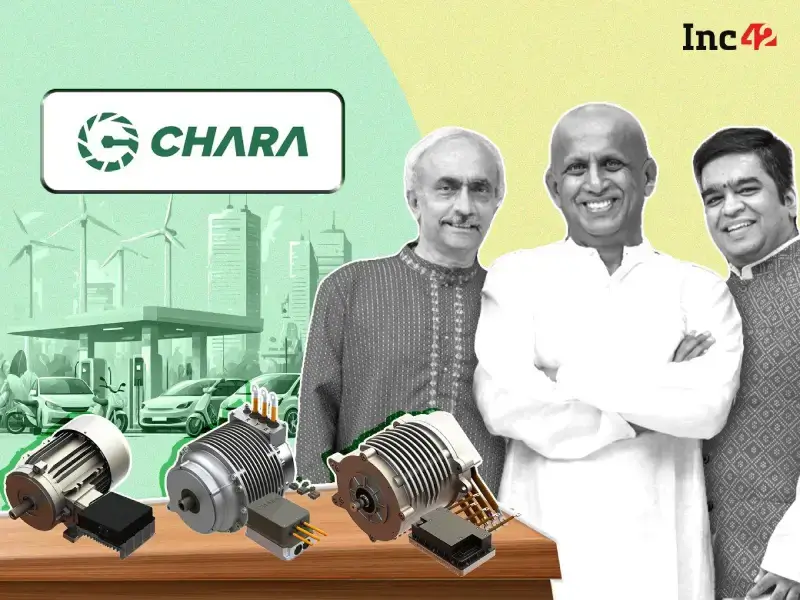
Chara’s journey from IISc Bengaluru to building rare-earth-free motors is exactly the kind of India-to-global sustainability story that defines the future of mobility.
What is the news?
- Bengaluru-based Chara Technologies has developed synchronous reluctance motors that eliminate dependency on rare earth elements, targeting 15,000 motor sales by FY26 with potential $5M revenues.
- Founded in 2019 by former Ezetap cofounder Bhaktha Keshavachar along with Mahalingam Koushik and Ravi Prasad, the startup raised $850K in seed funding from Kalaari Capital, CIIE.CO and others, followed by $4.75M in Pre-Series A from Exfinity Venture Partners. They’re currently in the process of raising Series A of INR 50-60 Cr.
- The company serves 50 customers globally, including European firms, exports to two European companies, and counts Godrej, Greaves Cotton, and Sonalika as top Indian clients. They’re scaling from 150 motors/month to 2,000 motors/month by end-2025.
Why is it interesting?
- This is India solving a critical global problem that China’s rare earth monopoly has created. With China controlling 90% of rare earth minerals and recently banning exports, Chara’s motors are 5% more efficient than traditional rare-earth motors while addressing the $400Bn EV industry’s biggest vulnerability. Their technology uses reluctance to generate torque, solving 200-year-old engineering challenges through computational power and enhanced algorithms.
- The timing is perfect. Geopolitical tensions over rare earths have created a massive market opportunity, and Chara’s ARAI and ICAT-certified motors offer 92% duty cycle efficiency vs 87% for traditional PMSM motors.
- When an Indian startup can deliver better range (147km vs 138.5km) without rare earth dependency, it positions India as the alternative supply chain the world desperately needs. This is deeptech with global impact, born from Indian innovation labs.
Read more: This Indian Startup Is Ditching China’s Rare Earth Grip With Smarter EV Motors